
Cyprus · Accountant
Quarter closed. Package sent.
Invoices, receipts, the summary and the return files go to your accountant as one download link. You need no shared drive and no second login, and nobody chases receipts.

Friday, 18:40. Nineteen tax categories and a bank account in Cyprus.
The tax treatment is derived, not picked from a list.
Other tools hand you nineteen tax categories and let you guess. Invobookz asks four questions (your country, the customer’s country, the customer’s type, the kind of service) and derives what belongs on the invoice.
Other tools ask for a “tax category” and put 19.00 in front of you, even on a Cyprus account. A tool that has to explain nineteen categories to you leaves the decision to you. We derive it: from your country, the customer’s country and type, their VIES status, and the kind of service.
Steuerschuldnerschaft des Leistungsempfängers gemäß Artikel 196 der Richtlinie 2006/112/EG.
In the program the real VIES status of the VAT ID decides, not an assumption. An unverified number leads to a different result.
tax cases under test, each one stored as a table of cases.
questions instead of nineteen categories. A tool that has to explain categories to you leaves the decision to you.
fields of the Cyprus VAT return, computed from your receipts. Plus VIES, month by month.
Your data stays in the EU, separated per client. The database itself enforces the separation.

The decision was made before you had to make it.
One invoice, from the blank sheet to the box on the return.
Instead of a feature list, this page follows a single document: the four questions at the start, the number it gets when it is finalised, the money on the bank statement, and the box it ends up in. At every stop, what other programs do there stands beside it.
The VAT ID is verified before it reaches the document.
Invobookz asks the European Commission’s VIES service and keeps the answer as a consultation number with a date, not just as a tick. That is the evidence an audit wants to see. It travels onto the document and stays there, even if the customer later moves or loses the number.
A number printed on an invoice is not yet a verified number. We ask VIES and keep the consultation number as evidence. That confirmation is what counts if it is ever disputed.
The rate and the discount sit on the same line.
One document can carry 19 %, 9 %, 5 %, 0 % and reverse charge at once: four Cypriot rates plus a supply where the recipient owes the tax. So Invobookz decides per line, and the discount goes per line too. On the total it could only be split by guessing which rate takes how much of it.
On a document carrying 19 % and reverse charge side by side, a discount on the total cannot be split. With us it goes on the line, where the rate is.
Nothing changes after this point.
Finalising draws the number from the sequence, with no gaps and in the order things were finalised. At the same moment the tax decision freezes, together with the mandatory wording verbatim and the customer’s VIES status. The PDF is produced and kept, not recomputed every time someone opens it. Corrections happen through a credit note, never by editing.
Art. 196 of the VAT Directive belongs on the invoice verbatim, in its language. With us it comes along, is frozen when the invoice is finalised and is never rewritten after that.
Other tools calculate something. Invobookz stops.
What runs past here are real results from the function that also writes your invoices. Where tax law gives no clear answer, it leaves the decision to you and tells you why.
Reverse charge. The recipient owes the tax.
0 % · box 6 · 8B · VIES
Cypriot VAT at the standard rate.
19 % · box 6 · 1
Outside the scope: the place of supply is outside Cyprus.
0 % · box 6 · 10
Blocked. The supply counts as made in Greece: foreign tax law, possibly a duty to register there.
no program decides that
Reverse charge pursuant to Article 196 of Directive 2006/112/EC.
verbatim, in the language of the invoice
Nothing changes after this point. Corrections go through a credit note, never through editing.
number, rate and wording freeze
19 %, 5 % and 0 % side by side: three lines, no blended rate on the total.
the sum of the lines counts
Blocked. Without a verified number it is not settled whether reverse charge applies.
get it wrong and you owe the tax yourself
The balance check does not add up: the statement is rejected, not half imported.
CAMT.053 · more formats on request
If two transactions fit equally well, neither is chosen.
ambiguous is not a match
Box 8B of the quarter against the sum of the three VIES months, and the result is on the screen.
two routes to the same number
The thirteen boxes of the Tax For All form, computed from your documents.
not a liability summary
And where something is unclear, it stops
This is the most important promise on this page. Where a figure is missing or contradicts itself, it says “blocked” instead of showing a number that merely looks plausible. A return that must not be filed says so at the very top, and names the receipt it is about.

And the receipt that has been in the glovebox since Tuesday.
The receipt is in before it disappears into the glovebox.
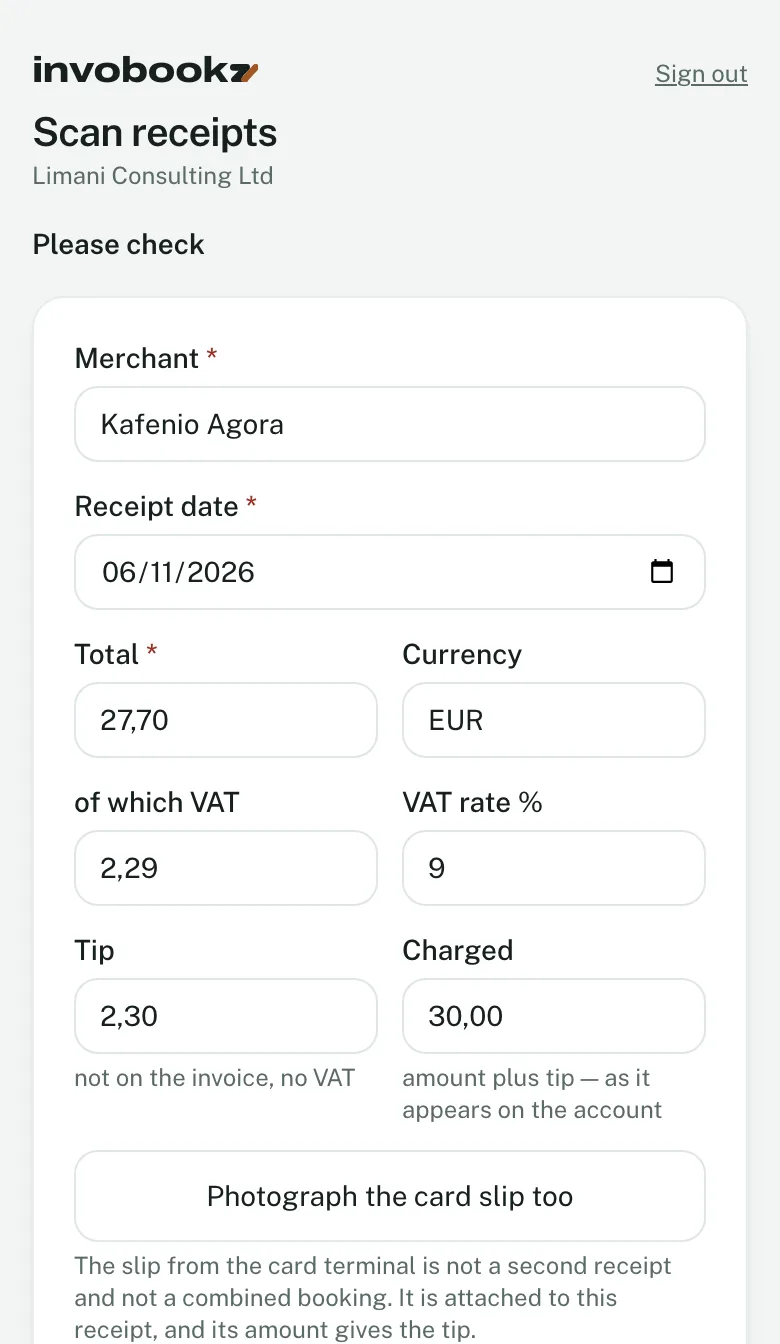
scan.invobookz.com on your phone: take a photo, the figures are there, you check and save. You need no app store, and there is nothing left to type up in the evening.
- Long receipts
- The weekly shop doesn't fit on one picture. Several photos make one receipt and are read together.
- Every VAT rate separately
- 19%, 5% and 0% on one receipt are recognised line by line, not as a blended rate on the total.
- Card slip and tip
- Photograph the slip from the card terminal too: it becomes page 2 of the same receipt, and the tip is recorded next to it (without VAT).
- Several receipts, one payment
- Paid for fuel and shop at one till? The receipts become one combined entry that matches the single bank line.
- Forgot something? Reopen it
- Reopen a receipt you just saved on your phone and complete it, as long as it hasn't been processed further.
- Can only add receipts
- The scanner can't reach any invoice or setting, and it asks for two-factor sign-in too.
What comes in is treated with the same care.
The outgoing invoice is one half. The other half is the receipts you pay and the money that actually moved. Both belong in the same return, and both are where programs become imprecise without anyone noticing.
Reading receipts
Photograph them or drop them in your cloud. Invobookz reads merchant, date and every VAT rate separately. What counts is the sum of the lines, not one blended rate across the whole receipt. In Cyprus a till receipt with 19 %, 5 % and 0 % side by side is the normal case.
Matching the bank
CAMT.053 or your bank's format, once you send us a sample statement. The balance check is a condition: if it doesn't add up, the statement is rejected rather than half-imported. Then receipt and booking find each other by number, name and amount, in both directions. If the match is ambiguous, none is chosen.
Bank connected directly
Invobookz reads Revolut Business, Airwallex, Qonto and Mercury directly, with a key you create at your bank yourself: read only and with no provider in between. Transactions come in every hour, without anyone downloading a file. Any other bank goes through the statement.
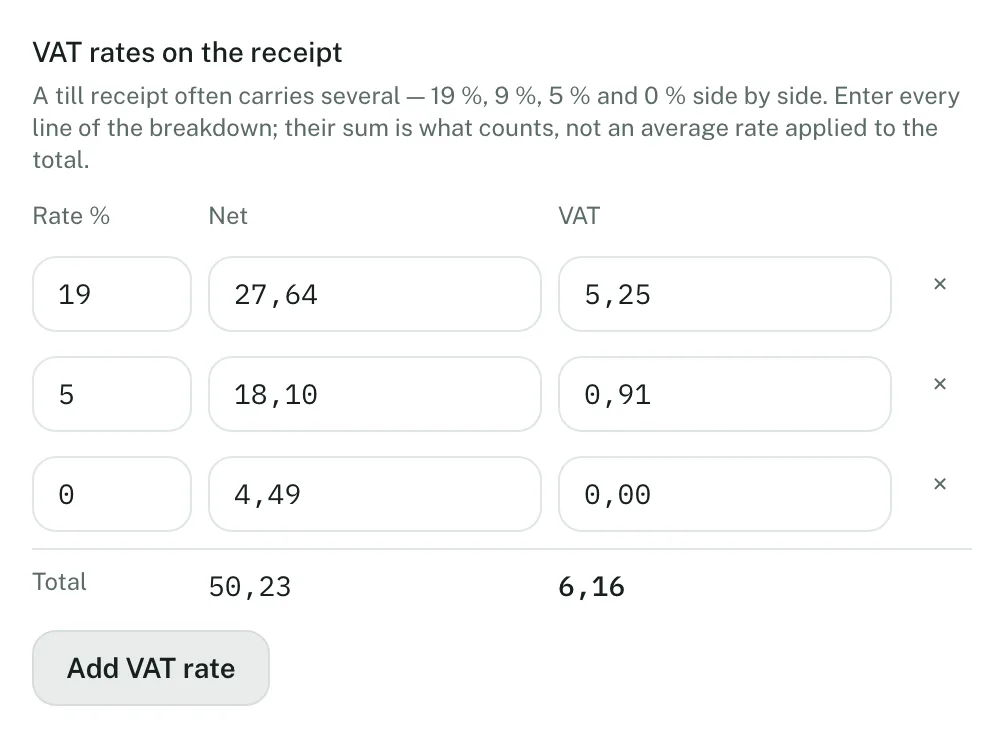

At the end of the quarter it comes down to thirteen boxes.
The Cyprus tax module
This is the part Invobookz exists for. Instead of adding up what you typed in, it derives what applies and computes the return itself.
The €550 from the top of this page goes in right here: into box 6 and box 8B, and into that month’s VIES return. Nobody retypes it, or exports it and keys it in again. The same document is carried through to the boxes where it belongs.
In the end you export numbers and retype them in the portal. We compute the thirteen fields of the Cyprus return and the monthly VIES report from your receipts. The cross-check holds field 8B against the sum of the VIES months.
- The tax decision is derived: from your country, the customer’s country and type, their VIES status, and the kind of service. 68 cases under test.
- VAT return each quarter: the thirteen fields of the Tax For All form, not a summary of what is owed.
- VIES each month, one line per customer, rounded to whole euros per line.
- The cross-check between them: field 8B of the quarter against the sum of the three VIES months.
- VAT numbers verified against VIES, with the consultation number as evidence.
- Reverse charge with the mandatory wording under Art. 196, in the language of the invoice, frozen when finalised.
- Four Cyprus rates (19 %, 9 %, 5 % and 0 %), as many side by side on one document as it takes.
- And where something is missing: blocked, with the receipt it is about right next to it.
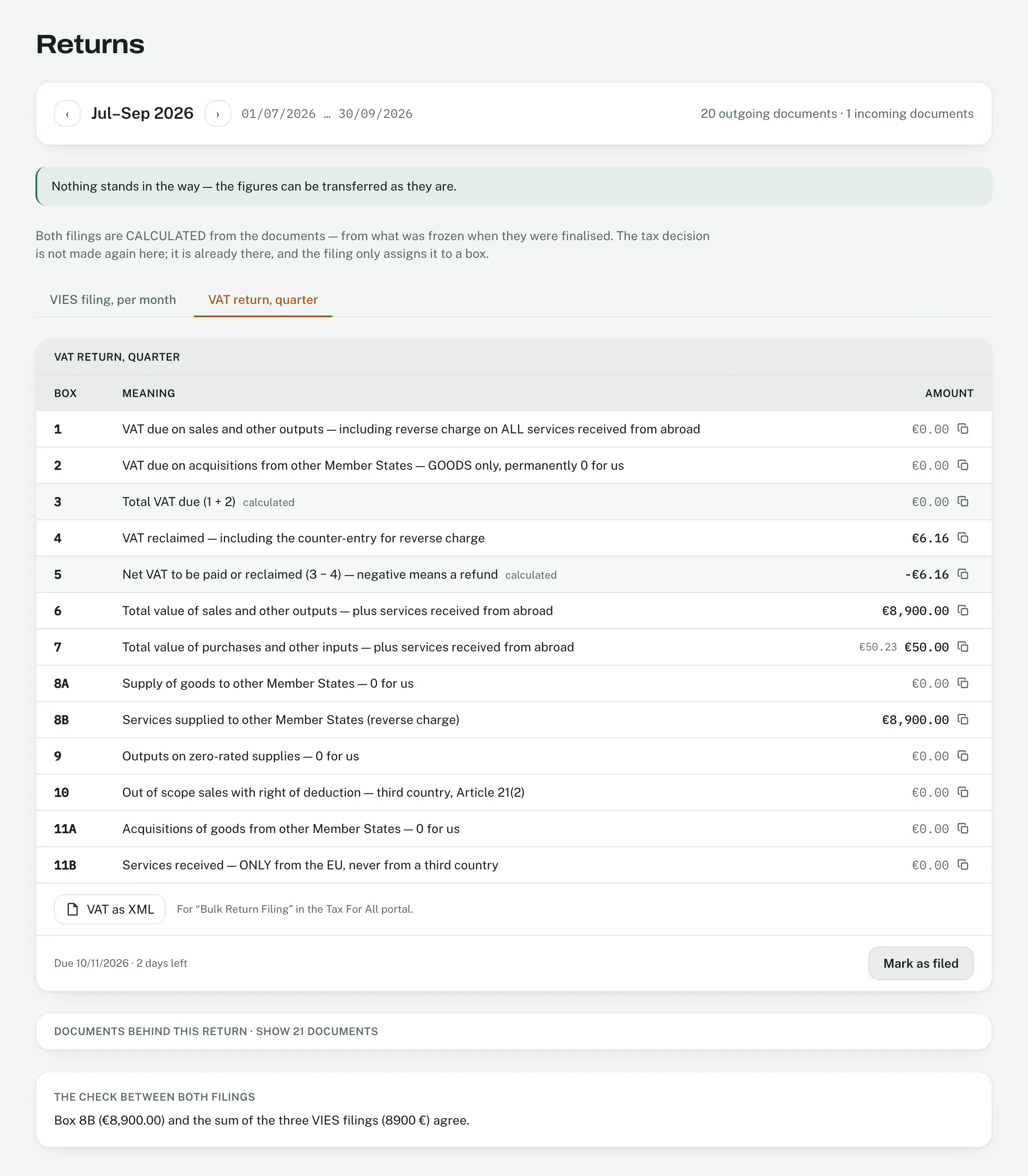
The same decision, for your system.
Till, shop, your own software: whatever triggers an invoice on your side can create it here, finalise it and fetch the PDF. The one thing it cannot do is send the tax rate along.
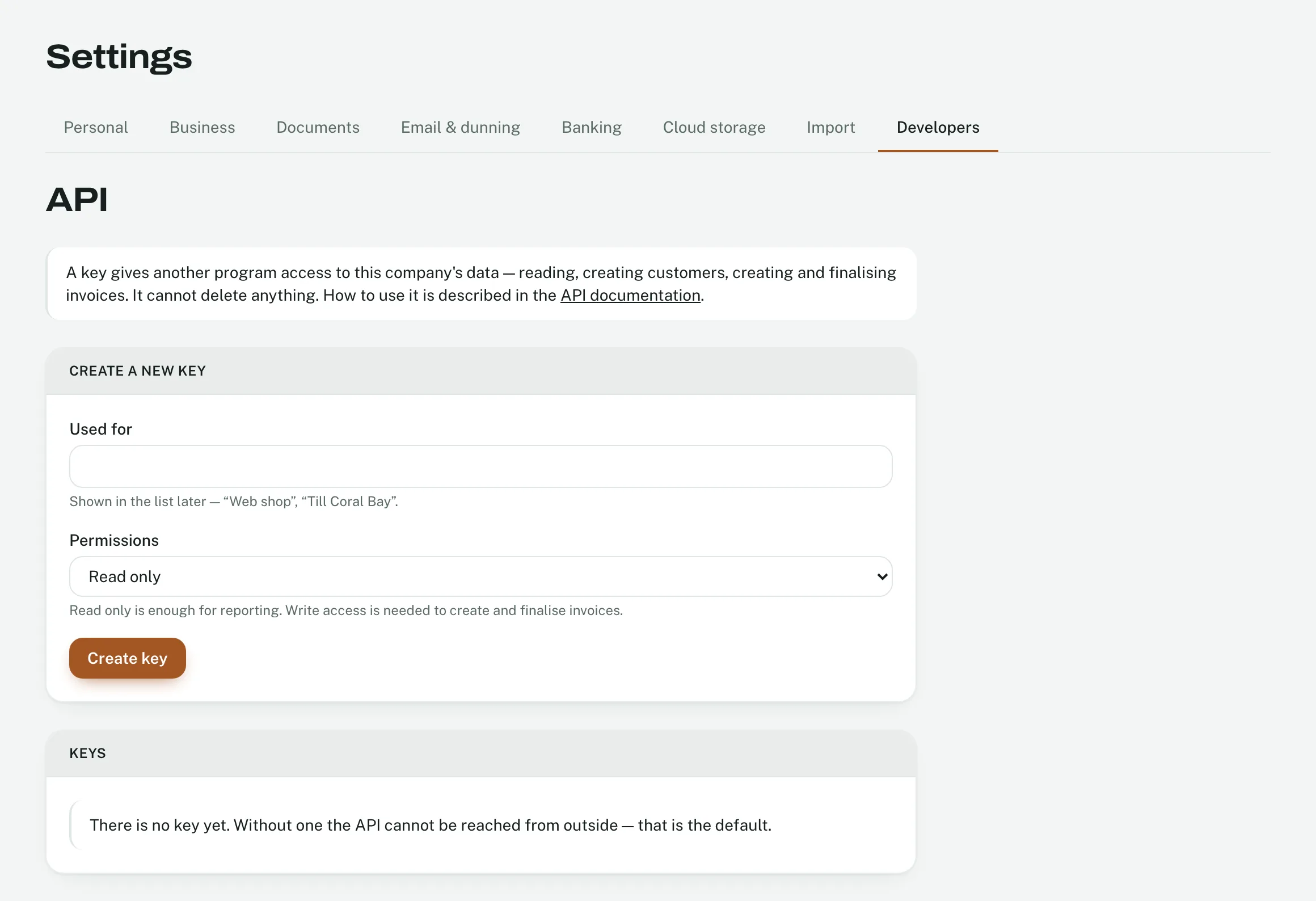
See the whole interfacePOST /v1/invoicesAuthorization: Bearer ibz_live_…{ "customer_id": "clx8f2q1…", "line_items": [{ "service_type_id": "clx3a9h7…", "name": "Beratung Juni", "quantity_milli": 1000, "unit_price_minor": 55000 }]}- "tax_rate"
- "tax_category"
- "tax_minor"
- "invoice_number"
{ "success": true, "data": { "status": "FESTGESCHRIEBEN", "number": "INVOICE-2026-0147", "tax_minor": 0, "net_minor": 55000, "total_minor": 55000, "mandatory_notes": ["rc_eu_b2b"], "customer_vies_consultation_number": "CY202606174711" }}The caller gets the result but cannot influence it: the number, the tax amount, the mandatory wording and the VIES consultation number are produced here and returned. The wording itself is printed on the PDF, which the same key can fetch.
Nine endpoints
Company, service types, items, customers, invoices: create, finalise, cancel, fetch the PDF. Read and write are separate rights per key.
Shown once
The key is displayed exactly once; only its SHA-256 is stored. The list shows when it last did any work, and “never” there means something different from “a long time ago”.
120 calls a minute
A sliding window, counted per server instance. That is imprecise, and we say so. Security rests on the key’s 256 bits, not on the throttle.
No CORS
There is no Access-Control-Allow-Origin header. Using the key from a browser would mean putting it there, and that should not be possible.
What you get
- Invoices
- Quote, invoice, credit note, cancellation. Your own number ranges, your own template with logo and colours, dispatch with a frozen PDF.
- Receipts
- Photograph them or drop them in the cloud. Merchant, date, amounts and every tax rate are read separately. What counts is the sum of the lines, not a blended rate.
- Bank statements
- CAMT.053, the format most banks offer. Your bank provides something else, even just PDF? Send us a sample statement and we'll add it. The balance check stays a condition: if it doesn't add up, nothing is half-imported.
- Reconciliation
- Receipt and transaction find each other by number, name and amount, in both directions. If the match is ambiguous, none is chosen.
- VAT and VIES
- The thirteen fields of the Cyprus return each quarter and the VIES report each month. Both are computed, not just summarised.
- Team
- Invite by email; the person sets their own password. Roles for owner and bookkeeping, and for every account you choose whether two-factor sign-in is required.
- E-invoicing
- Every invoice is also an e-invoice: the PDF carries the machine-readable version to EN 16931 inside it (Factur-X, known in Germany as ZUGFeRD). That is for customers whose accounts system reads it in.
- Recurring invoices
- Repeat a finalised invoice monthly, quarterly or yearly: as a draft, finalised, or emailed straight to the customer. The tax treatment is derived afresh for every date.
- Quotes and payment online
- Your customer accepts a quote through a link, and it turns into the invoice. On Premium, every invoice carries a payment link through your own Stripe account.
- Access for your accountant
- Your accountant gets their own read-only access. Or they get the quarterly package with receipts, statements and return by link, no account needed.
- Receipt inbox
- Your company's own email address: forward supplier invoices and Invobookz files them as receipts. If invoice and receipt arrive in one email, it asks instead of booking twice.
- Two-factor sign-in
- With an authenticator app and recovery codes, in the phone receipt scanner too. One account opens every receipt of a business, so it is protected by more than a password.
Evidence instead of adjectives
Data in Frankfurt
Database and application run in the EU, in Frankfurt to be exact.
Separated in the database
The database itself separates the clients, so a mistake in the application code cannot get around it.
Reading receipts is opt-in
Receipts are read only if you explicitly allow it. The consent text says where the image goes, with the provider and the country.
Third-party passwords encrypted
Your cloud password is stored encrypted, the key kept elsewhere. The log records that it was changed, but never its value.
Pricing
Two plans, both net and cancellable monthly. A 14-day trial before; pay yearly and two months are on us.
Starter
or €14.90 a month
For day-to-day business.
- 1,000 receipts and invoices a year
- 100 AI readings a month
- 5 GB storage
- Invoices, receipts, bank reconciliation
- Sent via invobookz.com, replies reach you
- Customers pay by bank transfer
Premium
or €19.90 a month
With the Cyprus tax module.
- Unlimited receipts and invoices
- 300 AI readings a month
- 10 GB storage
- Tax module: VAT and VIES for Cyprus
- Send from your own domain
- Stripe payment link on every invoice
- The Cyprus tax moduleVAT return each quarter: the thirteen fields of the Tax For All form, not a summary of what is owed.
All prices net. VAT follows your country.
Questions that come before signing up
Twelve of them, the awkward ones included. A question we leave out here still gets asked, only later and with more annoyance.
01Does Invobookz replace my accountant?
No. Invobookz writes the invoices, reads the receipts, reconciles the bank and calculates the return. The year-end accounts of a Cyprus company are signed off by a licensed auditor, and no software may do that. What changes is what you bring to them.
02Do you file my return with the Tax Department?
No, you do. Invobookz calculates the thirteen boxes of the Tax For All form and the VIES months and lays them out ready to copy, or as XML for Bulk Return Filing. The last click in the portal stays with you, and that is deliberate: what gets filed is what you have seen.
03Who is this built for?
For sellers established in Cyprus who invoice services, whether company or sole trader. Goods are not covered: the 68 tested cases are written for services, and we do not promise what we have not tested.
04Why not Xero, QuickBooks or Sage?
Because there a person picks the tax treatment from a list, and it is no different at the Cyprus vendors: nineteen entries at one, seven at another. The wrong pick only surfaces at the audit. Invobookz asks four questions (your country, the customer's country, the customer type, the type of service), checks the VAT ID against VIES and derives what applies.
05What happens when something is missing?
It says “blocked”, with the document it depends on right beside it. Invobookz does not fill in a plausible number or an estimate like “roughly 19 %”. A return that must not be filed says so at the top.
06Does my bank connect?
Revolut Business, Airwallex, Qonto and Mercury yes, directly and read-only, with a key you create at your bank yourself. No service provider sits in between reading along. Any other bank goes via the statement: CAMT.053, or you send us a sample statement and we add your bank's format. The balance check is a condition: if it doesn't add up, the statement is rejected rather than half-imported.
07Where is my data?
Database and application run in Frankfurt. The separation between tenants sits in the database itself, not in the application code, so a bug in the code cannot get around it. If you want, your documents also go to your own cloud, on any server that speaks WebDAV.
08Who reads my receipts?
Only if you allow it. Extraction is voluntary and switched on separately; the consent text names the provider and the country, today Anthropic in the United States. The privacy notice lists all five processors with purpose and location.
See the five processors09Can I get out again?
At the press of a button. An archive with a JSON and a CSV file per table, and every document file in the original. It is built fresh on every request, because a stored export would be a second set of books lying around and going stale.
10Can my accountant work in it?
Yes, with a role of their own: they read and export, they do not write, and they never cost a seat.
11Can I bring my existing data across?
Yes, on your own. Under Settings · Import you upload three tables as CSV; templates are there to download. A dry run shows what would come in and writes nothing. Each record is recognised by its number, and two runs in a row change nothing. Your invoice numbers carry on: we read the pattern from your last one instead of starting you at 0001.
12What does it cost, and how do I leave?
€14.90 or €19.90 net per month, cancel monthly. 14 days to look around with the full scope; the card is stored when you sign up, the charge comes only after that. We are cheaper than the others because we sell less: no payroll, no company formation, no bookkeeper filing on your behalf.

Set it up once. After that it is just the island again.
Questions?
You can create an account with the button above in two minutes. If something needs clearing up first, drop us a line.
€14.90 or €19.90 a month, net · 14-day trial · cancel monthly